


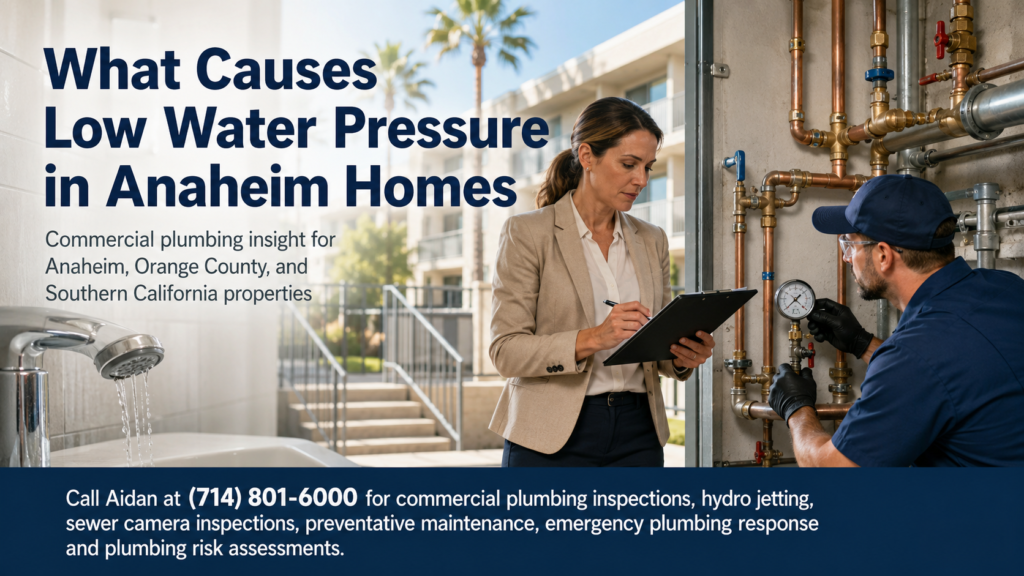
What Causes Low Water Pressure in Anaheim Homes and Commercial Properties?
Low water pressure in Anaheim homes and commercial buildings is usually caused by aging plumbing infrastructure, mineral buildup from Southern California hard water, failing pressure regulators, partially closed valves, hidden leaks, corroded pipes, fixture restrictions, or larger municipal and building-side plumbing issues.
For property managers, facility managers, HOA boards, multifamily operators, and commercial building owners, low water pressure is not just an inconvenience. It is often an early warning sign that the plumbing system needs inspection, documentation, maintenance, or repair before a larger emergency develops.
In Anaheim, Orange County, and nearby Southern California communities, water pressure issues can affect resident satisfaction, restroom operations, tenant complaints, laundry performance, commercial kitchens, irrigation systems, water heaters, and fire/life-safety-related building systems. When ignored, low water pressure can also point to hidden damage, moisture concerns, pipe restrictions, insurance-related documentation needs, and property damage prevention risks.
Quick Answer: Why Is the Water Pressure Low?
Low water pressure is commonly caused by:
- Mineral scale inside pipes
- Aging galvanized or corroded piping
- Failing pressure-reducing valves
- Partially closed shutoff valves
- Hidden leaks inside walls, ceilings, slabs, or underground lines
- Clogged aerators, showerheads, cartridges, or fixture supply lines
- Water heater restrictions
- Main line restrictions
- Sewer or drain-related backups affecting fixture performance
- Municipal supply issues
- Poor plumbing design from remodels or additions
- Multi-unit demand problems during peak usage times
For commercial and multifamily properties, the more important question is not only, “Why is the pressure low?” The better question is, “What does this pressure problem reveal about the condition, age, risk level, and maintenance needs of the plumbing system?”
That is where plumbing infrastructure intelligence becomes valuable.
Why Low Water Pressure Matters for Property Managers and Commercial Operators
Low water pressure creates frustration fast.
A tenant may first notice it as a weak shower. A restaurant may notice slow sink fill times. A facility manager may receive complaints from multiple restrooms. A maintenance team may assume it is “just one fixture,” only to discover later that the problem is connected to a larger piping restriction or hidden leak.
For commercial properties, apartment communities, HOAs, hotels, retail centers, schools, healthcare offices, and industrial buildings, water pressure issues can affect:
- Resident satisfaction
- Tenant retention
- Online reviews
- Building operations
- Emergency maintenance calls
- Health and sanitation expectations
- Insurance documentation
- Water damage prevention
- Liability reduction
- Operational continuity
Low water pressure is not always an emergency, but it can become one when the root cause is ignored.
A weak fixture may be a clogged aerator. A weak building may be a failing pressure regulator. A sudden pressure drop may be a hidden leak. A recurring pressure issue may be a sign of aging plumbing infrastructure that needs a capital planning conversation.
Common Causes of Low Water Pressure in Anaheim and Orange County Properties
1. Aging Plumbing Infrastructure
Many Anaheim and Orange County buildings were built decades ago. Over time, pipes naturally age, corrode, scale, restrict, and weaken.
Older properties may contain:
- Galvanized steel piping
- Copper piping with internal scale
- Older valves
- Outdated pressure regulators
- Mixed piping from remodels
- Slab piping
- Underground service lines
- Original fixture supply lines
As pipes age, the inside diameter can become smaller due to corrosion, scale, and buildup. Water may still move through the system, but not at the volume or pressure tenants expect.
Why this matters commercially
For property managers and facility directors, aging plumbing is not only a repair issue. It is an asset management issue.
Low water pressure can help identify:
- Which buildings or units are showing early failure signs
- Which lines may need inspection
- Which repairs should be documented
- Which recurring complaints may share the same root cause
- Which areas may require preventative maintenance or capital budgeting
This is plumbing asset management, not guesswork.
2. Southern California Hard Water and Mineral Buildup
Anaheim and much of Southern California deal with hard water. Hard water contains minerals that can collect inside pipes, fixtures, valves, water heaters, tankless systems, showerheads, faucet aerators, and appliance lines.
Over time, mineral buildup can reduce flow and create pressure complaints.
Common hard water restriction points include:
- Faucet aerators
- Showerheads
- Angle stops
- Fixture cartridges
- Water heater connections
- Tankless water heater heat exchangers
- Mixing valves
- Supply lines
- Laundry valves
- Commercial kitchen fixtures
Commercial example
A multifamily property may receive repeated complaints from residents that showers feel weak. The issue may not be the city water supply. It may be mineral buildup at shower cartridges, fixture stops, or building piping affected by years of hard water exposure.
A restaurant may notice slow hot water delivery at hand sinks. That may point to scale buildup in supply lines, mixing valves, or the water heater system.
Hard water does not usually cause one dramatic failure overnight. It slowly reduces performance until tenants, residents, or employees start complaining.
3. Failing Pressure-Reducing Valves
A pressure-reducing valve, often called a PRV, helps control the pressure coming into a building. When it fails, pressure may become too high, too low, or inconsistent.
Low water pressure may happen when the PRV is:
- Old
- Corroded
- Incorrectly adjusted
- Stuck
- Blocked by debris
- Failing internally
- Undersized for the property demand
Why this matters for liability prevention
Both high and low pressure can create problems.
High water pressure can damage pipes, valves, fixtures, water heaters, toilet parts, supply lines, and appliance connections. Low pressure can trigger complaints, sanitation concerns, equipment performance issues, and operational interruptions.
For commercial properties, PRV condition should be documented as part of a plumbing risk assessment, especially when there are recurring pressure complaints.
4. Partially Closed Shutoff Valves
Sometimes low water pressure has a simple cause: a valve is not fully open.
This can happen after:
- Emergency repairs
- Unit turnovers
- Water heater service
- Fixture replacement
- Tenant maintenance work
- Contractor activity
- Irrigation repairs
- Building shutoffs
Common valves that may restrict water include:
- Main shutoff valves
- Unit isolation valves
- Angle stops
- Water heater valves
- Laundry valves
- Commercial fixture stops
- Irrigation valves
Operational concern
In a commercial or multifamily property, incomplete valve restoration can create unnecessary tenant complaints and service calls.
Good documentation matters. When a plumber or maintenance team performs work, the final condition of valves should be noted. Which valves were touched? Were they reopened? Was water pressure tested after the repair?
That documentation protects the property, the manager, the maintenance team, and the service provider.
5. Hidden Leaks
A sudden drop in water pressure may point to a leak.
Hidden leaks may occur:
- Behind walls
- Under slabs
- In ceilings
- In underground service lines
- Around water heaters
- Inside mechanical rooms
- In irrigation systems
- In tenant spaces after hours
- In common-area restrooms
- In vacant units
Low pressure combined with moisture concerns should be taken seriously.
Warning signs may include:
- Damp drywall
- Musty odors
- Warm flooring
- Unexplained water bills
- Mold-like staining
- Ceiling discoloration
- Soft baseboards
- Pooling near exterior walls
- Water meter movement when fixtures are off
Insurance-related concern
When water damage is possible, documentation becomes critical.
Property managers should document:
- Date and time of complaint
- Affected unit or area
- Photos of visible damage
- Moisture observations
- Water meter readings if available
- Plumbing inspection findings
- Repair recommendations
- Communication with tenants
- Emergency response actions
- Before-and-after photos
This type of insurance documentation can help support claim communication if damage is discovered.
6. Fixture-Level Restrictions
Not every pressure issue is building-wide. Sometimes the problem is isolated to one fixture.
Common fixture-level causes include:
- Clogged faucet aerators
- Debris in showerheads
- Failed cartridges
- Blocked supply lines
- Corroded angle stops
- Scale in mixing valves
- Toilet fill valve restrictions
- Commercial sink valve issues
Direct answer
If only one sink, shower, toilet, or fixture has low pressure, the problem is likely at the fixture, valve, cartridge, aerator, or supply line.
If several fixtures have low pressure, the issue may be related to piping, pressure regulation, water heater systems, building zones, or the main supply.
This distinction helps reduce wasted service calls and improves plumbing infrastructure intelligence.
7. Water Heater Restrictions
Low hot water pressure is often different from low cold water pressure.
If cold water pressure is normal but hot water pressure is weak, the issue may involve:
- Water heater valves
- Sediment buildup
- Tankless scale buildup
- Heat exchanger restriction
- Dielectric union corrosion
- Recirculation pump issues
- Mixing valve problems
- Hot-side piping restrictions
Commercial example
A hotel, apartment building, restaurant, salon, or healthcare facility cannot afford unreliable hot water performance. Low hot water pressure can affect sanitation, resident comfort, customer experience, and operational continuity.
For tankless systems in hard water areas, annual descaling and maintenance may help reduce scale-related performance problems.
8. Main Water Line Restrictions
The main water line brings water into the property. If the main line is restricted, undersized, leaking, or damaged, the entire property may experience low water pressure.
Possible main line issues include:
- Aging pipe
- Underground leak
- Corrosion
- Root interference near underground utilities
- Partially closed main valve
- Debris after utility work
- Undersized service line
- Pressure regulator failure
- Meter or backflow device restriction
Why this matters for commercial buildings
A main line problem can affect multiple tenants at once. That turns a plumbing issue into an operations issue.
A property manager may suddenly face:
- Multiple tenant complaints
- Restroom disruptions
- Business interruption concerns
- Possible emergency repair costs
- After-hours response needs
- Documentation requirements
- Vendor coordination
- Tenant communication pressure
This is why emergency plumbing prevention is better than waiting for a complete loss of service.
9. Demand Problems in Multifamily and Commercial Buildings
Sometimes pressure drops during peak usage.
This may happen when too many fixtures are being used at the same time.
Common peak-demand times include:
- Morning shower hours
- Evening laundry use
- Restaurant prep and cleanup periods
- School restroom breaks
- Gym peak hours
- Hotel check-in and morning checkout windows
- Irrigation schedules overlapping with building use
What this may reveal
Peak-demand pressure issues may suggest:
- Undersized piping
- Poor plumbing design
- Old infrastructure
- Pressure regulator limitations
- Booster system problems
- Valve restrictions
- Water heater capacity issues
- Distribution imbalance across zones
This is where plumbing asset management becomes important. The goal is not just to “fix pressure.” The goal is to understand building performance.
10. Sewer and Drain Problems That Look Like Pressure Problems
Water pressure and drain performance are different systems, but tenants often describe plumbing problems in simple terms.
A resident may say, “The water is not working right,” when the actual issue is:
- Slow drainage
- Toilet gurgling
- Sewer odor
- Backup risk
- Drain line restriction
- Venting issue
- Main sewer line problem
- Grease buildup
- Root intrusion
- Fixture trap restriction
This is why sewer camera inspections and hydro jetting may be relevant when pressure complaints are part of a broader plumbing performance pattern.
When sewer camera inspections help
Sewer camera inspections can help identify:
- Root intrusion
- Broken pipe sections
- Bellied sewer lines
- Grease accumulation
- Scale buildup
- Offset joints
- Recurring blockage points
- Construction debris
- Foreign objects
- Main line restrictions
When hydro jetting helps
Hydro jetting may help clean drain and sewer lines when buildup is causing recurring clogs, slow drains, backups, or maintenance problems.
For commercial kitchens, apartments, HOAs, and retail centers, hydro jetting can be part of a preventative maintenance plan, especially where recurring stoppages create tenant complaints or liability exposure.
Low Water Pressure as a Risk-Management Signal
For commercial properties, low water pressure should be treated as a signal, not just a symptom.
It can indicate:
- System age
- Hidden leaks
- Scale buildup
- Valve failures
- Water heater problems
- Poor maintenance history
- Pipe corrosion
- Tenant misuse
- Construction-related damage
- Undocumented plumbing changes
- Main line restrictions
The risk is not only the pressure issue itself. The greater risk is missing what caused it.
How Low Water Pressure Affects Resident Satisfaction
In multifamily and HOA environments, water pressure issues quickly become emotional.
Residents may feel:
- Ignored
- Inconvenienced
- Concerned about rent value
- Worried about water damage
- Frustrated by repeat service visits
- Skeptical if the same issue keeps returning
For property managers, this creates a communication challenge.
The best response is not vague reassurance. The best response is documented action:
- Inspection completed
- Pressure tested
- Fixture checked
- Valve condition noted
- Photos taken
- Cause identified when possible
- Repair options provided
- Preventative recommendations documented
That turns a complaint into a managed process.
Liability Reduction: Why Documentation Matters
Low water pressure may seem minor until a hidden leak, water damage event, or mold-related moisture concern appears later.
Good documentation can help show that the property took reasonable steps.
Helpful records include:
- Work order history
- Tenant complaint logs
- Photos
- Inspection notes
- Pressure readings
- Moisture observations
- Leak detection findings
- Camera inspection reports
- Hydro jetting records
- Repair invoices
- Preventative maintenance schedules
- Recommendations declined or approved
- Communication timelines
For insurance-related concerns, documentation can help establish what was observed, when action was taken, and what recommendations were made.
This is not about overcomplicating plumbing. It is about protecting the property.
Hidden Damage Detection: What Managers Should Watch For
Low pressure can sometimes be connected to hidden water loss.
Watch for these signs:
- Sudden pressure drop across multiple fixtures
- Water meter movement when fixtures are off
- Unexplained increase in water bills
- Moisture near walls or baseboards
- Ceiling stains below bathrooms or kitchens
- Hot spots on floors
- Musty odors
- Repeated drywall repairs
- Mold-like staining
- Soft flooring
- Recurring complaints in the same stack or building zone
When pressure issues and moisture concerns appear together, the property should act quickly.
Preventative Maintenance for Water Pressure Issues
A preventative approach may include:
Pressure testing
Measure incoming water pressure and fixture-level performance.
Valve inspection
Check main valves, isolation valves, angle stops, water heater valves, and commercial fixture stops.
Regulator inspection
Evaluate the condition and performance of pressure-reducing valves.
Fixture inspection
Check aerators, cartridges, showerheads, supply lines, and tenant-space fixtures.
Water heater maintenance
Flush tank systems when appropriate, descale tankless units, and inspect hot-side pressure issues.
Leak detection review
Look for signs of hidden leaks, meter movement, moisture, and unexplained water usage.
Sewer camera inspections
Use camera inspections when recurring drain issues, backups, or main line concerns are part of the property history.
Hydro jetting
Use hydro jetting for preventative drain maintenance where grease, buildup, roots, or recurring stoppages create risk.
Documentation
Record findings, photos, pressure readings, recommendations, and follow-up actions.
Preventative maintenance is not just about avoiding emergencies. It is about creating a documented history of responsible property care.
Commercial Examples: How Low Pressure Shows Up
Apartment community
Residents in one building complain about weak showers. The issue may be mineral buildup, fixture cartridges, old piping, or pressure imbalance in that building zone.
HOA community
Several units experience inconsistent pressure. The issue may involve shared infrastructure, aging valves, or a main supply restriction.
Restaurant
Hand sinks and dishwashing areas experience weak hot water flow. The issue may involve water heater scale, mixing valves, supply restrictions, or hard water buildup.
Retail center
Multiple tenants report restroom performance issues. The issue may be tied to pressure regulation, valve settings, supply lines, or main line performance.
Hotel or motel
Guest complaints increase during peak morning hours. The issue may involve system demand, booster performance, water heater capacity, or pipe sizing.
Medical or dental office
Low water flow affects sanitation expectations and daily operations. The issue needs fast documentation and professional evaluation.
What Property Managers Should Ask When Low Pressure Is Reported
A good intake process helps identify the likely cause faster.
Ask:
- Is the issue hot water, cold water, or both?
- Is it one fixture or multiple fixtures?
- Is it one unit, one building, or property-wide?
- Did it start suddenly or gradually?
- Does it happen all day or only during peak use?
- Are there any leaks, stains, odors, or moisture concerns?
- Has recent plumbing work been performed?
- Were any valves recently shut off?
- Are there recurring drain or sewer complaints in the same area?
- Has the property had past pressure regulator issues?
- Are there recent water bill changes?
These questions help separate simple fixture problems from larger infrastructure concerns.
When Low Water Pressure Needs Immediate Attention
Call for professional plumbing evaluation quickly when:
- Pressure drops suddenly across the property
- Multiple tenants complain at the same time
- Low pressure is paired with moisture concerns
- Water bills increase unexpectedly
- Hot water pressure drops significantly
- Toilets, sinks, or drains are also backing up
- A main line leak is suspected
- A commercial operation is interrupted
- Pressure problems affect sanitation or resident habitability
- There is visible water damage
Fast response supports emergency plumbing prevention, property damage prevention, and liability reduction.
Why Repeated Pressure Complaints Should Not Be Treated as Isolated Work Orders
One of the biggest operational mistakes is treating each pressure complaint as a separate event.
For example:
- Unit 104 has weak shower pressure.
- Unit 204 has weak shower pressure.
- Unit 304 reports hot water problems.
- Building B has recurring complaints.
- The same stack has repeated plumbing calls.
Individually, each issue may look minor. Together, they may reveal a pattern.
That pattern may point to:
- A vertical riser issue
- Shared piping restriction
- Pressure imbalance
- Valve failure
- Old galvanized piping
- Water heater distribution issue
- Hard water scale
- Building zone problem
This is where plumbing infrastructure intelligence matters. The property needs more than a repair invoice. It needs a useful record of what the plumbing system is telling the management team.
Plumbing Risk Assessments: A Smarter Way to Manage Pressure Issues
A plumbing risk assessment helps identify current problems, likely future risks, and preventative priorities.
For water pressure issues, a risk assessment may include:
- Pressure readings
- Valve condition
- Visible corrosion
- Fixture performance
- Water heater condition
- Signs of leaks
- Moisture concerns
- Drain and sewer history
- Camera inspection recommendations
- Hydro jetting recommendations
- Emergency shutoff review
- Documentation for property records
- Repair priority ranking
This supports better budgeting, fewer surprises, and stronger communication with ownership, boards, tenants, and insurance stakeholders.
Direct Answer for Voice Search: What Causes Low Water Pressure in Anaheim Homes?
Low water pressure in Anaheim homes is usually caused by hard water mineral buildup, old pipes, corroded valves, failing pressure regulators, hidden leaks, clogged fixtures, water heater restrictions, or main line problems. In multifamily and commercial properties, repeated low pressure should be inspected and documented to reduce risk and prevent emergencies.
FAQs About Low Water Pressure in Anaheim and Orange County Properties
What is the most common cause of low water pressure?
The most common causes are fixture restrictions, old valves, mineral buildup from hard water, pressure regulator problems, and aging pipes. If the pressure issue affects only one fixture, the problem is usually local. If it affects multiple fixtures, the issue may be larger.
Is low water pressure an emergency?
Sometimes. Low pressure becomes urgent when it happens suddenly, affects multiple units, appears with moisture concerns, follows a suspected leak, or disrupts commercial operations. Sudden pressure loss should not be ignored.
Can hard water cause low water pressure?
Yes. Hard water can leave mineral scale inside fixtures, valves, water heaters, and piping. Over time, this buildup may reduce water flow and create pressure complaints.
Can a hidden leak cause low water pressure?
Yes. A hidden leak can reduce pressure and create water damage. Warning signs include moisture, stains, musty odors, unexplained water bills, warm flooring, or water meter movement when fixtures are off.
Why is only the hot water pressure low?
Low hot water pressure may involve sediment, scale, water heater valves, tankless heat exchanger buildup, mixing valves, or restrictions in hot water piping.
Why do pressure problems happen more during mornings or evenings?
Peak demand can reduce pressure when many tenants or fixtures use water at the same time. This may reveal undersized piping, poor distribution, regulator issues, or aging building infrastructure.
Should a property manager document low water pressure complaints?
Yes. Documentation helps track patterns, support maintenance decisions, communicate with tenants, reduce liability, and provide useful information if insurance-related concerns arise.
Can sewer camera inspections help with low water pressure?
Sewer camera inspections do not diagnose water supply pressure directly, but they are useful when pressure complaints are part of a broader plumbing pattern involving slow drains, backups, sewer odors, gurgling toilets, or recurring stoppages.
When is hydro jetting recommended?
Hydro jetting may be recommended when drain or sewer lines have grease, scale, roots, sludge, or recurring buildup. It is often used as part of preventative maintenance for commercial kitchens, multifamily properties, HOAs, and buildings with repeat drain problems.
How can commercial properties prevent pressure-related emergencies?
The best approach is regular plumbing inspections, pressure testing, valve checks, water heater maintenance, leak detection, sewer camera inspections when needed, hydro jetting for recurring drain risk, and clear documentation.