



How Sewer Camera Inspections Help Property Managers Defend Maintenance Decisions
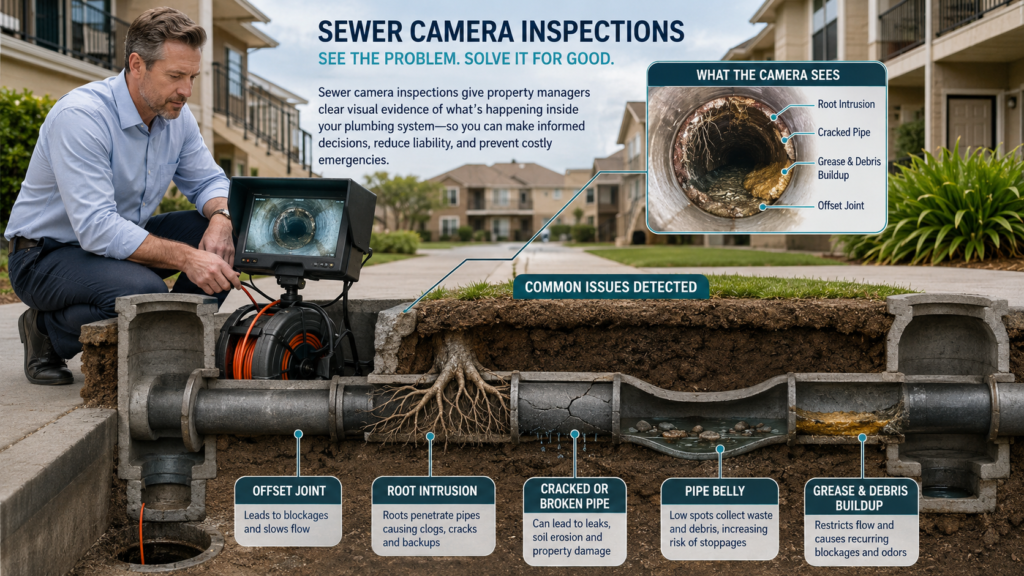
Sewer Camera Inspection Property Managers rely on provides visual documentation that helps justify maintenance decisions, support repair recommendations, reduce liability, and communicate sewer line conditions to owners, boards, regional managers, and residents. Video evidence often removes uncertainty and helps stakeholders understand why action is necessary.
When a tenant says, “The plumbing problem keeps coming back,” or an owner asks, “Why are we spending money on this again?” property managers often find themselves caught between incomplete information and urgent operational pressure.
That is where sewer camera inspections become one of the most valuable tools in commercial plumbing asset management.
Instead of relying on assumptions, temporary drain clearing, or incomplete diagnostics, sewer camera inspections provide visual evidence of what is actually happening inside the plumbing infrastructure. For multifamily housing, HOAs, commercial buildings, mixed-use properties, retail centers, and community associations throughout Anaheim and Orange County, this technology has become a critical risk-management and documentation tool.
Why Property Managers Need Plumbing Infrastructure Intelligence
Many commercial plumbing systems across Southern California are aging rapidly.
Older multifamily communities and commercial properties throughout Anaheim, Fullerton, Brea, Orange, Costa Mesa, Santa Ana, and nearby Orange County areas frequently experience:
- recurring drain backups
- root intrusion
- deteriorating cast iron piping
- grease accumulation
- slab leak risks
- offset pipe joints
- sewer bellies
- scale buildup
- water pressure issues
- moisture concerns behind walls or under flooring
Unfortunately, many plumbing problems remain hidden until they become emergencies.
By the time tenants report sewage odors, repeated clogs, flooding, or slow drains, the underlying damage may already be affecting resident satisfaction, insurance exposure, operational continuity, and long-term repair costs.
Sewer camera inspections allow property managers to move from reactive maintenance to preventative plumbing intelligence.
What Is a Sewer Camera Inspection?
A sewer camera inspection uses a specialized waterproof camera inserted into drain and sewer lines to visually inspect the inside condition of the plumbing system in real time.
The camera allows plumbing professionals to identify:
Hidden Plumbing Problems
- root intrusion
- pipe corrosion
- cracks and fractures
- collapsed piping
- grease buildup
- foreign object obstructions
- scale accumulation
- offset joints
- pipe separation
- sewer line bellies
- recurring blockage locations
Moisture and Property Damage Risks
Camera inspections can help identify plumbing failures contributing to:
- hidden moisture concerns
- slab leak indicators
- sewer leakage
- recurring overflows
- structural damage risks
- mold-related moisture conditions
- hidden water migration
For property managers, this level of documentation creates defensible maintenance decisions instead of guesswork.
How Sewer Camera Inspections Help Defend Maintenance Decisions
Property managers are constantly balancing competing pressures.
Tenants want immediate solutions. Owners want controlled costs. Vendors need authorization. Insurance carriers require documentation. Online reviews can damage occupancy rates and reputation.
Sewer camera inspections help create objective evidence.
Visual Documentation Reduces Disputes
One of the biggest operational advantages of sewer camera inspections is visual proof.
Instead of saying:
“We think the line has roots,”
A property manager can provide:
“Here is the recorded video showing root intrusion at 47 feet.”
This changes the entire conversation.
Visual documentation helps:
- justify preventative maintenance
- explain recurring plumbing problems
- defend repair recommendations
- support vendor coordination
- demonstrate due diligence
- reduce owner skepticism
- improve insurance documentation
- reduce resident frustration
Why Recurring Plumbing Problems Frustrate Tenants
Tenants rarely care about plumbing infrastructure complexity.
What they experience is:
- another backup
- another odor complaint
- another disruption
- another emergency vendor visit
- another inconvenience
From the tenant perspective, recurring plumbing problems often appear as management inaction.
This creates emotional pressure on property managers.
Repeated drain backups and unresolved plumbing issues can affect:
- tenant retention
- online reviews
- resident trust
- lease renewals
- maintenance reputation
- property image
Sewer camera inspections help property managers communicate proactively rather than defensively.
Commercial Example: Multifamily Property in Anaheim
A multifamily property in Anaheim experienced recurring second-floor drain backups affecting multiple units over several months.
Previous service vendors performed repeated drain snaking without identifying the root cause.
Tenants became frustrated because the issue kept returning.
A sewer camera inspection later revealed:
- heavy root intrusion
- deteriorating cast iron sections
- improper slope conditions
- grease accumulation from multiple units
The inspection footage allowed property management to:
- document the underlying infrastructure condition
- justify hydro jetting services
- prioritize repair planning
- communicate clearly with ownership
- demonstrate proactive risk reduction
- reduce repeated emergency calls
Instead of appearing reactive, the management team now had evidence-based plumbing asset management documentation.
How Hydro Jetting Complements Sewer Camera Inspections
Hydro jetting and sewer camera inspections are often paired together in commercial plumbing maintenance programs.
What Hydro Jetting Does
Hydro jetting uses high-pressure water to remove:
- grease buildup
- sludge
- debris
- scale accumulation
- soft root intrusion
- recurring drain obstructions
Why Camera Inspections Matter First
A sewer camera inspection helps determine:
- whether hydro jetting is appropriate
- the condition of aging pipes
- blockage severity
- structural risks
- recurring problem locations
This prevents unnecessary guesswork and helps property managers make informed maintenance decisions.
Emergency Plumbing Prevention Starts Before Emergencies
Many late-night plumbing emergencies are not truly “sudden.”
They are often the result of hidden conditions that were developing over time.
Examples include:
- slow root intrusion
- gradual grease accumulation
- deteriorating cast iron piping
- unnoticed moisture concerns
- hidden sewer line separation
- pressure-related pipe stress
Preventative sewer camera inspections help identify these conditions early.
For commercial and multifamily properties in Orange County, preventative maintenance is often far less expensive than:
- emergency restoration
- tenant displacement
- insurance claims
- flooring replacement
- drywall replacement
- mold remediation
- business interruption
- reputation damage
Insurance Documentation and Liability Reduction
Insurance-related plumbing claims frequently involve one major question:
“Could the damage have been prevented?”
Property managers who maintain documented plumbing inspections are often in a stronger position when addressing:
- insurance investigations
- maintenance disputes
- owner concerns
- tenant complaints
- vendor accountability
- moisture-related claims
How Sewer Camera Documentation Helps
Inspection reports and video documentation may support:
- maintenance timelines
- preventative maintenance efforts
- repair recommendations
- contractor coordination
- loss mitigation documentation
- risk assessments
- plumbing infrastructure records
This becomes especially important in large commercial buildings, HOAs, apartment communities, and mixed-use properties throughout Southern California.
Aging Plumbing Infrastructure in Southern California
Many Anaheim and Orange County commercial properties were built decades ago.
Common aging infrastructure concerns include:
- cast iron pipe corrosion
- clay sewer line root intrusion
- galvanized pipe buildup
- aging cleanouts
- deteriorating sewer laterals
- inconsistent water pressure
- slab leak risks
Without plumbing infrastructure intelligence, property managers are often forced into reactive emergency spending.
Sewer camera inspections help create a more strategic maintenance roadmap.
The Operational Benefits for Property Managers
Better Vendor Coordination
Camera inspections allow property managers to:
- share findings with ownership
- coordinate vendors more effectively
- compare repair recommendations
- prioritize repairs
- schedule preventative maintenance
Reduced Emergency Response Stress
Preventative inspections reduce:
- after-hours emergency calls
- repeated dispatches
- tenant escalations
- operational disruptions
Improved Budget Planning
Documented infrastructure conditions help property managers:
- anticipate future repairs
- phase maintenance projects
- avoid surprise failures
- prioritize capital improvements
When Property Managers Should Schedule Sewer Camera Inspections
Commercial properties should strongly consider sewer camera inspections when experiencing:
- recurring drain backups
- repeated tenant complaints
- foul sewer odors
- unexplained moisture concerns
- multiple plumbing calls in the same area
- aging plumbing infrastructure
- water pressure inconsistencies
- frequent hydro jetting needs
- prior sewer repairs
- insurance-related water damage concerns
Preventative inspections are especially valuable before:
- major renovations
- tenant turnover
- property acquisitions
- reserve studies
- insurance renewals
- rainy season preparation
Why Preventative Plumbing Maintenance Protects Property Value
Commercial plumbing systems are part of the property’s operational infrastructure.
Ignoring hidden plumbing conditions can eventually affect:
- resident satisfaction
- occupancy stability
- insurance exposure
- property reputation
- maintenance costs
- operational continuity
- long-term asset value
Property managers who prioritize preventative maintenance often experience fewer catastrophic plumbing events and more predictable maintenance planning.
Why Property Managers Use Sewer Camera Inspections
Property managers use sewer camera inspections because they provide visual evidence of hidden plumbing problems, recurring blockage causes, aging infrastructure conditions, and moisture-related risks. This helps reduce liability, improve insurance documentation, support preventative maintenance decisions, coordinate vendors, reduce tenant complaints, and prevent expensive emergency plumbing failures.
FAQs
How often should commercial properties schedule sewer camera inspections?
Many multifamily and commercial properties benefit from periodic inspections every 1–3 years depending on property age, tenant density, plumbing history, and recurring drain activity.
Can sewer camera inspections detect hidden damage?
Yes. Sewer camera inspections can identify root intrusion, cracked pipes, corrosion, offset joints, sewer bellies, blockages, and other hidden plumbing infrastructure concerns.
Do sewer camera inspections help with insurance documentation?
Yes. Video documentation and inspection reports may help support maintenance records, preventative maintenance efforts, and property condition documentation.
What is the difference between hydro jetting and sewer camera inspections?
Sewer camera inspections diagnose plumbing conditions visually. Hydro jetting cleans the inside of pipes using high-pressure water.
Can sewer camera inspections reduce tenant complaints?
Yes. Identifying and resolving recurring plumbing problems at the root cause level can reduce repeat disruptions and improve resident satisfaction.