



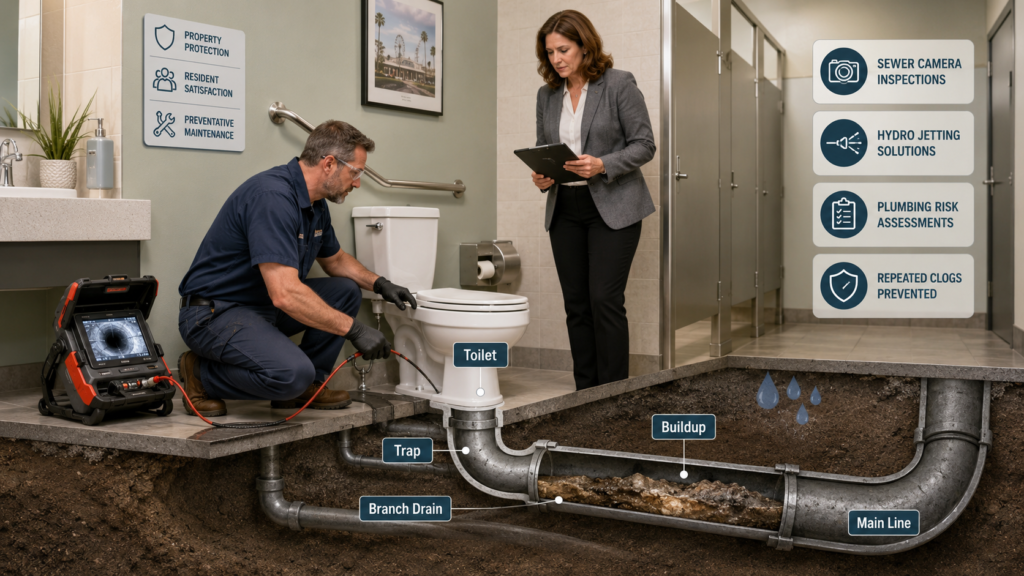
Why Toilets Clog Again and Again
Toilets clog again and again because the visible blockage is often only the symptom. In commercial and multifamily properties, repeat toilet clogs may point to deeper drainline buildup, aging sewer piping, low-flow fixture issues, tenant misuse, hidden pipe damage, poor venting, or mainline restrictions.
For property managers, facility managers, HOA managers, restaurant operators, retail managers, and commercial building owners in Anaheim, Orange County, and nearby Southern California communities, recurring toilet clogs are not just maintenance annoyances. They are risk signals.
A single clogged toilet can create tenant complaints. A repeat clog can create operational disruption. A backed-up restroom can affect customer experience, employee productivity, resident satisfaction, health concerns, moisture damage, insurance documentation, and liability exposure.
The real question is not only:
“Can we clear the toilet today?”
The better question is:
“Why does this toilet keep clogging, and what does this tell us about the property’s plumbing system?”
Featured Snippet Answer
Toilets clog repeatedly when there is an unresolved problem inside the toilet, branch drain, vent system, sewer line, or main building drain. Common causes include excessive paper use, foreign objects, low-flow toilet performance, mineral buildup, aging pipes, root intrusion, belly sections, grease buildup, poor slope, or mainline restrictions. A sewer camera inspection and plumbing risk assessment can help identify the real cause.
Why Repeat Toilet Clogs Matter in Commercial Properties
In a home, a clogged toilet is frustrating.
In a commercial property, it can become a management problem.
Repeat toilet clogs can affect:
- Tenant satisfaction
- Resident complaints
- Online reviews
- Customer access to restrooms
- Employee morale
- Emergency service costs
- Property damage prevention
- Moisture concerns
- Insurance documentation
- Liability reduction
- Operational continuity
For apartments, condos, office buildings, restaurants, medical offices, schools, retail centers, and hospitality properties, restrooms are part of the public-facing experience. When toilets back up repeatedly, people rarely blame the pipe. They blame management.
That is why repeated toilet clogs deserve a root-cause approach, not just another temporary clearing.
The Direct Commercial Answer: A Toilet Clog Is Often a System Clue
A toilet is only one visible fixture connected to a much larger plumbing system.
Behind the toilet may be:
- A trapway inside the toilet
- A flange connection
- A branch drain line
- A vent connection
- A shared bathroom group line
- A building drain
- A sewer lateral
- A cleanout access point
- A city sewer connection
When the same toilet clogs again and again, the fixture may not be the true problem. The issue may be downstream.
For property managers and facility teams, this matters because clearing the bowl without investigating the line can create a false sense of resolution. The toilet works today, but the underlying restriction remains.
That is how repeat service calls happen.
Common Reasons Toilets Clog Again and Again
1. The Toilet Was Cleared, But the Drainline Was Not
Many clogs are cleared just enough to restore temporary flow.
That does not mean the pipe is clean.
A cable may punch a hole through the blockage, allowing water to pass, while debris remains along the pipe walls. In commercial properties, this can include:
- Paper buildup
- Wipes
- Feminine hygiene products
- Grease migration from nearby lines
- Hard water scale
- Soap residue
- Sediment
- Sludge
- Foreign objects
The toilet may flush normally for a few days or weeks, then clog again when new material catches on the remaining buildup.
This is one reason hydro jetting may be recommended for certain commercial drain systems. Hydro jetting uses high-pressure water to clean the inside walls of the pipe, not just open a small path through the clog.
2. Tenants or Occupants Are Flushing the Wrong Items
In multifamily and commercial properties, the person reporting the clog is not always the person who caused it.
Common clog-causing items include:
- “Flushable” wipes
- Paper towels
- Feminine hygiene products
- Cotton swabs
- Dental floss
- Diapers
- Cleaning wipes
- Food waste
- Disposable gloves
- Small packaging
- Excessive toilet paper
This creates a frustrating emotional problem for managers. The resident may say, “The plumbing keeps failing,” while the actual issue may be repeated misuse.
Documentation becomes important. Photos, drain findings, technician notes, and sewer camera inspection results can help show whether the problem is misuse, pipe condition, or both.
That matters for liability reduction, tenant communication, owner reporting, and insurance documentation.
3. Low-Flow Toilets May Struggle in Older Drain Systems
Low-flow toilets save water, but they can expose problems in older plumbing systems.
Some aging buildings in Anaheim, Orange County, and Southern California were built with drain systems designed around older toilets that used more water per flush. When lower-flow fixtures are installed, the reduced water volume may not always move waste through older horizontal drainlines effectively, especially if the pipe already has:
- Low slope
- Buildup
- rough interior surfaces
- Long drain runs
- Offset joints
- Bellies or sagging sections
- Partial blockages
This does not mean low-flow toilets are bad. It means the plumbing system must be evaluated as a system.
A plumbing risk assessment can help determine whether repeat toilet clogs are related to fixture performance, pipe condition, water volume, or downstream restrictions.
4. Hard Water Scale and Mineral Buildup Can Narrow Drain Paths
Southern California is known for hard water. Hard water contains minerals that can leave buildup over time.
Most people think about hard water affecting faucets, showerheads, and water heaters. But mineral buildup can also contribute to rougher interior surfaces and reduced flow conditions in plumbing systems.
In commercial restrooms, mineral buildup can combine with:
- Urine scale
- Paper residue
- Cleaning chemical residue
- Soap and organic matter
- Sediment
- Older pipe corrosion
The result is a pipe interior that catches debris more easily.
Once the pipe interior becomes rough or restricted, clogs can become more frequent.
5. Aging Plumbing Infrastructure May Be Creating Hidden Restrictions
Anaheim and many Orange County communities have a mix of older buildings, remodeled properties, multifamily communities, retail centers, and commercial spaces with plumbing systems that have been modified over time.
Aging plumbing infrastructure may include:
- Cast iron drain lines
- Clay sewer lines
- Older ABS or PVC repairs
- Mixed-material connections
- Settlement-related pipe shifts
- Root-prone sewer laterals
- Poorly documented remodel tie-ins
- Older cleanout locations
- Limited access points
Repeated toilet clogs may be an early warning sign that the drain system has hidden damage or reduced capacity.
For property managers, this is where plumbing infrastructure intelligence becomes valuable. You are not just fixing a toilet. You are learning something about the building.
6. A Mainline Restriction Can Show Up as Toilet Problems
Toilets are often the first fixture people notice when a sewer line has trouble.
A repeat toilet clog may be caused by a problem farther downstream, such as:
- Main sewer line buildup
- Root intrusion
- Pipe collapse
- Offset pipe joint
- Grease accumulation
- Sewer belly
- Foreign object lodged in the line
- Heavy scale or sludge buildup
If multiple fixtures are affected, or if the same restroom group keeps backing up, the problem may be beyond the toilet.
Warning signs include:
- More than one toilet backing up
- Gurgling drains
- Water backing up into tubs or floor drains
- Sewage odor
- Slow drainage in nearby fixtures
- Repeat clogs in the same area
- Backups after heavy use
- Clogs that return shortly after clearing
These symptoms should trigger a deeper inspection.
7. Poor Venting Can Affect Toilet Performance
Toilets need proper air movement in the drainage system. Venting helps waste and water move properly through the drainline.
If the vent system is blocked, undersized, damaged, or poorly configured, the toilet may struggle to flush consistently.
Possible vent-related warning signs include:
- Gurgling sounds
- Weak flushing
- Water level changes in the bowl
- Sewer gas odors
- Slow drainage
- Repeated clogs without obvious blockage
For commercial properties, venting issues can be difficult to diagnose without experienced plumbing evaluation. They are also easy to overlook if the focus stays only on clearing the toilet.
8. Water Pressure Issues Can Affect the Larger Plumbing System
Water pressure issues are usually discussed with supply lines, fixtures, and water heaters. But in commercial property management, water pressure is part of the broader plumbing risk picture.
High water pressure can stress supply components, angle stops, flushometer valves, toilet fill valves, and connected fixtures. Low water delivery or inconsistent fixture performance can contribute to complaints and maintenance confusion.
In commercial restrooms, water pressure and fixture performance should be evaluated together, especially when complaints include:
- Weak flush
- Long tank refill time
- Running toilets
- Flushometer problems
- Repeated stoppages
- Fixture leaks
- Moisture around toilet bases
A toilet problem may involve both the drain side and the supply side.
Why “Just Snake It Again” Can Become Expensive
Snaking may be appropriate for many stoppages. But repeat snaking without documenting the cause can become expensive and risky.
The hidden cost is not only the plumber invoice.
The larger cost may include:
- Repeat tenant complaints
- After-hours emergency calls
- Staff interruption
- Property manager time
- Resident dissatisfaction
- Restroom downtime
- Moisture damage
- Odor complaints
- Increased liability concerns
- Poor documentation
- Owner frustration
- Insurance complications
For property managers, repeat plumbing problems can create a credibility issue. Owners may ask why the same issue keeps happening. Tenants may claim the property is not maintaining the system. Staff may feel stuck between budget pressure and resident pressure.
That is why repeat clogs should be managed as risk events, not isolated annoyances.
Commercial Examples: What Repeat Toilet Clogs May Really Mean
Apartment Community
A second-floor unit toilet clogs three times in two months. The resident insists they are not flushing wipes. Maintenance clears it each time.
A sewer camera inspection shows a sagging branch line where waste is collecting. The property now has documentation showing the issue is infrastructure-related, not simply tenant behavior.
Restaurant or Retail Center
A customer restroom toilet backs up repeatedly during busy hours. Staff keeps plunging it. Eventually, the restroom floods and creates moisture concerns near adjacent flooring.
A plumbing inspection finds heavy buildup in the shared drain line. Hydro jetting and a maintenance schedule reduce emergency calls and help protect the customer experience.
Medical Office or Professional Building
A staff restroom has recurring clogs and sewer odor. The building manager receives complaints, but the issue seems intermittent.
A plumbing risk assessment identifies poor drainage performance and possible venting concerns. Documentation helps prioritize repairs before a more disruptive failure.
HOA or Condo Property
Multiple residents report toilet backups in the same stack or building section. Each unit believes the problem is inside their own bathroom.
A camera inspection helps identify whether the issue is in the unit line, shared line, or common sewer lateral. This supports clearer responsibility, better communication, and better decision-making.
Why Sewer Camera Inspections Matter for Repeat Toilet Clogs
A sewer camera inspection gives property managers visual information instead of guesswork.
It can help identify:
- Root intrusion
- Pipe cracks
- Offset joints
- Bellied pipe sections
- Heavy buildup
- Foreign objects
- Grease accumulation
- Broken pipe areas
- Poor transitions
- Aging pipe material
- Standing water in the line
For commercial properties, camera documentation is especially useful because it supports:
- Owner reporting
- Tenant communication
- Insurance documentation
- Repair prioritization
- Capital planning
- Vendor accountability
- Liability reduction
- Plumbing asset management
Without camera documentation, repeated toilet clogs often become a cycle of complaint, dispatch, clearing, invoice, and repeat complaint.
With documentation, the property can move from reaction to decision-making.
When Hydro Jetting May Be Part of the Solution
Hydro jetting is not just “stronger snaking.” It is a cleaning process designed to remove buildup from pipe walls when conditions allow.
Hydro jetting may be useful when repeat clogs are caused by:
- Sludge buildup
- Grease accumulation
- Heavy paper residue
- Scale-related restriction
- Organic buildup
- Recurring line restrictions
- Commercial restroom load
- Multifamily shared drain use
However, hydro jetting should be used with professional judgment. Older or damaged lines may need camera inspection first to confirm the pipe condition.
For aging plumbing infrastructure, the safest approach is usually:
- Inspect
- Document
- Identify the cause
- Recommend the correct option
- Prevent repeat failure where possible
This protects the property and reduces the risk of making a hidden pipe problem worse.
Moisture Concerns and Property Damage Prevention
A toilet clog can quickly become a moisture concern.
If a toilet overflows, water can affect:
- Flooring
- Baseboards
- Drywall
- Subflooring
- Cabinetry
- Adjacent units
- Lower floors
- Common areas
- Commercial tenant spaces
In multifamily and commercial buildings, even a small overflow can create documentation issues.
Property teams may need to know:
- Was the water clean, gray, or contaminated?
- How long was the area wet?
- Were adjacent materials affected?
- Was the issue reported promptly?
- Was the cause documented?
- Were photos taken?
- Was mitigation needed?
- Was the repeat risk addressed?
This is where plumbing and risk management overlap. A repeated toilet clog is not just a drain problem. It can become a property damage prevention issue.
Insurance Documentation: Why Notes Matter
Insurance carriers, owners, and property stakeholders often care about documentation.
For repeat toilet clogs, good documentation may include:
- Date and time of service
- Affected unit, restroom, or area
- Reported symptoms
- Technician findings
- Photos of affected conditions
- Camera inspection screenshots or video
- Cause of clog if identifiable
- Whether foreign material was found
- Whether multiple fixtures were affected
- Moisture observations
- Recommendations
- Preventative maintenance options
- Follow-up plan
This protects the property manager from vague disputes later.
It also helps show that the property took reasonable steps to inspect, respond, document, and reduce future risk.
Plumbing Risk Assessments for Repeat Toilet Problems
A plumbing risk assessment is a proactive review of plumbing conditions that may create future emergencies.
For repeat toilet clogs, a plumbing risk assessment may include:
- Fixture performance review
- Toilet model and flush performance check
- Supply and shutoff inspection
- Water pressure testing
- Visible leak inspection
- Drain flow evaluation
- Cleanout access review
- Sewer camera inspection
- Hydro jetting recommendation if appropriate
- Mainline risk evaluation
- Moisture concern observations
- Documentation of aging plumbing infrastructure
- Preventative maintenance schedule suggestions
This gives property managers better plumbing infrastructure intelligence.
Instead of saying, “We had another clog,” the manager can say:
“We inspected the restroom group, documented the line condition, identified the likely restriction, and created a preventative plan.”
That is a stronger management position.
Preventative Guidance for Property Managers and Facility Teams
Track Repeat Locations
Do not only track plumbing costs. Track locations.
Record:
- Unit number
- Restroom location
- Building number
- Floor
- Fixture type
- Date of clog
- Time of day
- Whether nearby fixtures were affected
- Whether foreign material was found
- Whether camera inspection was recommended
Patterns reveal risk.
Educate Residents and Occupants
Simple reminders can reduce preventable clogs.
Helpful restroom messaging includes:
- Toilet paper only
- No wipes, even if labeled flushable
- No paper towels
- No feminine hygiene products
- Report slow drains early
- Report gurgling or odors immediately
For apartments and condos, education is not about blame. It is about property protection.
Camera Inspect Repeat Problems
If the same toilet, restroom, stack, or building area clogs repeatedly, consider camera inspection.
The cost of documentation is often lower than the cost of continued emergency calls.
Use Hydro Jetting Strategically
Hydro jetting may help with repeat buildup when the line condition supports it.
This is especially relevant for:
- Multifamily properties
- Restaurants
- Retail centers
- Office buildings
- Schools
- Hospitality properties
- Older commercial buildings
Build a Preventative Maintenance Schedule
Commercial plumbing should not be managed only by emergency response.
A preventative plan may include:
- Scheduled drain cleaning
- Sewer camera inspections
- Hydro jetting where appropriate
- Water pressure checks
- Fixture inspections
- Shutoff valve checks
- Restroom group evaluations
- Documentation updates
Preventative maintenance supports operational continuity.
Warning Signs a Repeat Toilet Clog Needs Professional Evaluation
Call for a deeper plumbing inspection if you notice:
- The same toilet clogs repeatedly
- Multiple toilets clog in the same building
- Toilets gurgle after flushing
- Water backs up into tubs, showers, or floor drains
- Sewer odors are present
- Clogs return shortly after snaking
- There is moisture around the toilet base
- The toilet rocks or moves
- The restroom floods during peak use
- Tenants repeatedly complain about the same area
- Maintenance staff cannot identify the cause
- Older piping is present
- The property has a history of sewer backups
These are not just service issues. They are risk signals.
FAQ: Why Toilets Clog Again and Again
Why does the same toilet keep clogging?
The same toilet may keep clogging because of a partial blockage, low-flow toilet performance, foreign objects, poor drain slope, venting problems, hard water buildup, or a downstream sewer line restriction. A sewer camera inspection can help identify whether the issue is inside the toilet, branch line, or mainline.
Are repeat toilet clogs a sign of a sewer line problem?
They can be. If multiple fixtures are affected, if the clog returns quickly, or if water backs up into tubs, showers, or floor drains, the issue may involve the main sewer line or a shared building drain.
Should a property manager keep snaking the same toilet?
Snaking may temporarily restore flow, but repeated snaking without identifying the cause can lead to recurring complaints and emergency costs. If the same toilet or restroom clogs repeatedly, inspection and documentation are recommended.
Can hydro jetting fix recurring toilet clogs?
Hydro jetting may help when recurring clogs are caused by buildup inside the drainline. However, older or damaged pipes should be evaluated first, often with a sewer camera inspection, to confirm whether hydro jetting is appropriate.
Do flushable wipes cause commercial toilet clogs?
Yes. Many wipes do not break down like toilet paper and can collect inside pipes, especially in multifamily and commercial drain systems. Even wipes labeled “flushable” can contribute to repeat clogs and sewer backups.
Can hard water cause toilet clog problems?
Hard water can contribute to mineral buildup and rough pipe surfaces over time. In Southern California, hard water may combine with paper, urine scale, sludge, and aging pipe conditions to increase clog risk.
Why do toilets clog more in apartment buildings?
Apartment buildings have shared drain systems, higher usage, multiple occupants, and more opportunities for improper flushing. A clog may originate in one unit but affect another unit or shared line, making documentation important.
What should be documented after a repeat toilet clog?
Document the location, date, symptoms, affected fixtures, technician findings, photos, recovered materials, camera inspection results, moisture concerns, recommendations, and follow-up plan. Good documentation supports liability reduction and insurance communication.
When should a sewer camera inspection be performed?
A sewer camera inspection should be considered when clogs repeat, multiple fixtures are affected, there are sewer odors, backups occur, or the property has aging plumbing infrastructure. Camera inspection helps identify hidden damage and restrictions.
How can property managers prevent repeat toilet clogs?
Property managers can reduce repeat clogs by tracking problem locations, educating tenants, scheduling preventative drain maintenance, using sewer camera inspections, hydro jetting appropriate lines, and completing plumbing risk assessments.