



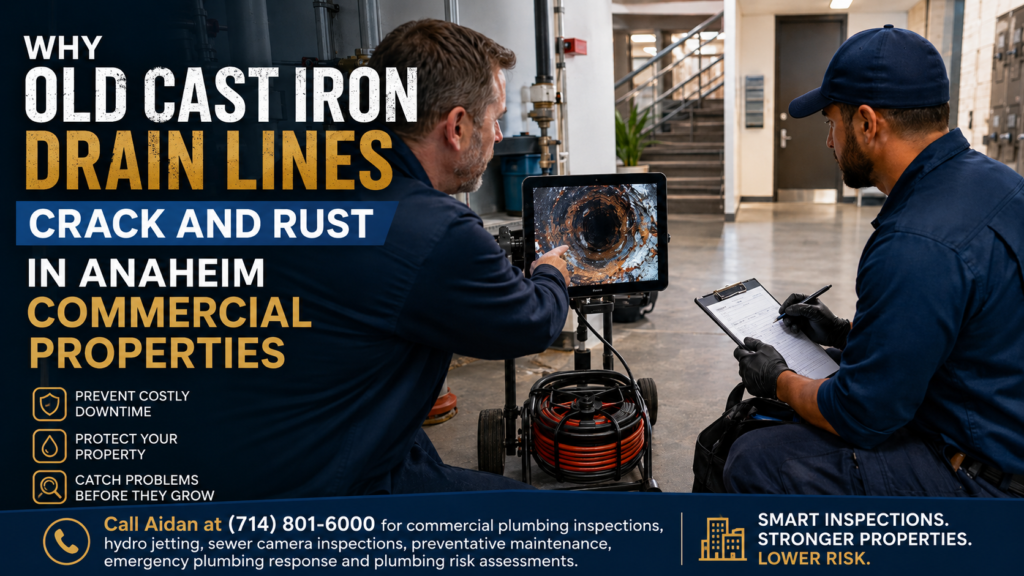
Why Old Cast Iron Drain Lines Crack and Rust
Old cast iron drain lines crack and rust because decades of wastewater, sewer gases, moisture, soil movement, corrosion, and internal scaling slowly weaken the pipe. In Anaheim, Orange County, and Southern California, aging plumbing infrastructure can turn hidden pipe deterioration into backups, leaks, tenant complaints, moisture concerns, and expensive property damage.
Quick Answer for Commercial Property Managers
Old cast iron drain lines usually fail from the inside out. The pipe may look solid from the outside, but inside the line, corrosion, rust scale, sludge buildup, and sewer gas exposure can eat away at the metal. Over time, the pipe wall gets thinner, rougher, and weaker.
For commercial properties, multifamily buildings, HOAs, restaurants, retail centers, schools, medical buildings, and older mixed-use properties, this is not just a plumbing issue. It is an operational risk.
A deteriorating cast iron drain line can create:
- Recurring drain backups
- Sewer odors
- Tenant complaints
- Moisture concerns behind walls or under slabs
- Mold-related risk
- Flooring or cabinet damage
- Business interruptions
- Insurance documentation challenges
- Liability exposure
- Emergency plumbing costs
That is why sewer camera inspections, hydro jetting when appropriate, plumbing risk assessments, and plumbing asset management matter before the pipe fails.
Why Cast Iron Drain Lines Were Common in Older Southern California Properties
Cast iron was widely used for drain, waste, and vent piping because it was strong, quiet, fire-resistant, and durable. Many older commercial buildings, apartment communities, condos, schools, and residential properties in Anaheim and Orange County still rely on original cast iron drain systems.
The challenge is age.
A cast iron pipe installed decades ago may have already endured:
- Thousands of gallons of wastewater
- Grease, soap, hair, paper, and organic buildup
- Harsh drain cleaners
- Ground movement
- Pipe joint separation
- Sewer gas exposure
- Repeated backups
- Moisture intrusion
- Slab movement
- Poor past repairs
- Deferred maintenance
In Southern California, many buildings have been remodeled, expanded, re-piped, tenant-improved, or partially repaired over time. That can leave property managers with a patchwork plumbing system: newer fixtures connected to older cast iron drain lines that were never fully evaluated.
That hidden mismatch is where risk begins.
How Old Cast Iron Drain Lines Rust from the Inside
Internal Corrosion Is the Main Problem
Most people imagine rust happening on the outside of a pipe. With cast iron drain lines, some of the most serious damage happens inside the pipe.
Wastewater contains organic material, bacteria, cleaning chemicals, soap residue, food waste, grease, and minerals. Inside the pipe, sewer gases and moisture create a corrosive environment. Over time, that corrosion can slowly wear down the cast iron wall.
The inside of the pipe can become:
- Rough
- Flaky
- Pitted
- Scaled
- Restricted
- Uneven
- Structurally weakened
Once the interior surface gets rough, waste no longer flows smoothly. Debris catches more easily. Grease sticks. Paper hangs up. Sludge builds. Flow slows down. Then the property starts seeing repeated drain complaints.
For a commercial property manager, the first sign may not be a visible leak. It may be the same restroom, unit, floor drain, kitchen line, or laundry area clogging again and again.
Why Cast Iron Drain Lines Crack
Cast iron drain lines crack when the pipe wall becomes brittle, thin, stressed, or unsupported. The crack may start small, but even a small opening can allow wastewater, sewer gas, or moisture to escape into hidden areas.
Common Causes of Cast Iron Cracking
1. Age and Metal Fatigue
Cast iron is strong, but it is not permanent. After decades of service, the pipe can lose wall thickness and structural integrity. The older the system, the more important documentation becomes.
For commercial properties, age alone should trigger a plumbing risk assessment, especially if the building has recurring drain issues.
2. Internal Rust and Pipe Wall Thinning
Corrosion slowly removes material from the inside of the pipe. As the wall gets thinner, the pipe becomes more vulnerable to cracking, splitting, or collapsing.
This matters because the outside of the pipe may still look acceptable during a basic visual inspection. A sewer camera inspection can reveal what the outside cannot.
3. Ground Movement and Slab Stress
Southern California buildings deal with soil movement, seismic activity, settlement, slab stress, and remodel-related structural changes. Cast iron lines under slabs can shift, sag, separate, or crack.
A small belly in the line can hold water and debris. A crack can allow soil to enter the pipe. A separation can cause recurring blockages and hidden moisture concerns.
4. Aggressive Drain Cleaning History
Years of emergency snaking, harsh chemical drain cleaners, and unmanaged backups can worsen pipe deterioration. Mechanical cleaning may temporarily restore flow, but if the pipe is badly corroded, the underlying problem remains.
Hydro jetting may help remove buildup in suitable lines, but old cast iron must be evaluated first. A sewer camera inspection helps determine whether the line is strong enough for cleaning or whether repair planning is needed.
5. Poor Repairs and Mixed Materials
Many older buildings have sections where cast iron connects to ABS, PVC, clay, copper, or other materials. If prior repairs were rushed or undocumented, the system may have weak transition points.
These transitions can create:
- Offset joints
- Improper slope
- Root intrusion points
- Leak points
- Debris-catching edges
- Recurring stoppages
For plumbing asset management, those transition points should be documented and tracked.
What Rust Does to Drain Flow Over Time
Old cast iron drain lines do not usually fail all at once. They create patterns.
The Flow Slowly Gets Worse
As the inside of the pipe rusts, the pipe loses its smooth interior surface. Wastewater has to move through a rough, narrowed, uneven passage.
That can lead to:
- Slower drainage
- Gurgling drains
- Sewer odors
- Frequent toilet backups
- Floor drain overflows
- Laundry drain issues
- Kitchen line grease buildup
- Lower operational reliability
- Emergency plumbing prevention concerns
For commercial properties, these problems often show up as tenant complaints before management sees visible damage.
Drain Issues Can Be Misdiagnosed
A drain line may be cleared multiple times without anyone documenting the true condition of the pipe. That creates a dangerous pattern: the symptom is treated, but the asset keeps deteriorating.
A property manager may hear:
- “The line is clogged again.”
- “The same unit keeps backing up.”
- “The restroom smells like sewer gas.”
- “The floor drain overflowed again.”
- “The tenant says this has happened before.”
- “The plumber cleared it, but it came back.”
That is when a sewer camera inspection becomes more than a plumbing service. It becomes infrastructure intelligence.
Why This Matters for Property Managers and Facility Teams
Cast Iron Failure Is an Operational Risk
A cracked or rusted cast iron drain line can disrupt far more than one bathroom.
In a multifamily property, it can affect resident satisfaction, renewal confidence, and reputation. In a commercial building, it can interrupt tenants, employees, customers, or patients. In a restaurant or retail center, it can affect sanitation, odor control, and business continuity.
For property managers and facility managers, old cast iron drain lines create risk in five major areas:
1. Liability Reduction
Repeated backups, sewage exposure, slippery floors, odors, and unresolved moisture concerns can increase liability exposure. Documentation helps show that management acted responsibly.
2. Resident and Tenant Satisfaction
No resident wants repeated plumbing problems. No commercial tenant wants sewer odors or restroom closures. Fast response matters, but prevention matters more.
3. Insurance Documentation
When water or sewage damage occurs, insurance-related documentation may become important. Photos, inspection notes, sewer camera findings, service history, and repair recommendations help support the timeline of events.
4. Property Damage Prevention
A hidden crack under a slab or behind a wall can release moisture slowly. By the time staining, odor, flooring damage, or mold concerns appear, the damage may already be expensive.
5. Operational Continuity
Emergency plumbing problems can shut down restrooms, kitchens, laundry rooms, common areas, offices, retail spaces, or tenant operations. Preventative maintenance helps reduce surprise failures.
Warning Signs of Old Cast Iron Drain Line Problems
Commercial properties should treat the following as risk signals, not minor annoyances.
Common Warning Signs
- Recurring drain clogs in the same area
- Sewer smells inside units, restrooms, or common areas
- Slow drains after repeated cleaning
- Gurgling toilets or drains
- Floor drain backups
- Wastewater stains
- Moisture concerns near walls, cabinets, or flooring
- Rust flakes found during drain cleaning
- Black sludge buildup
- Rodent or insect activity near drain areas
- Tenant complaints about odors or backups
- Wet soil or settlement near exterior drain paths
- Emergency calls during high-use periods
- Multiple fixtures backing up at once
If a building has old cast iron drain lines and these symptoms keep repeating, the issue may be more than a blockage. The pipe may be deteriorating.
Sewer Camera Inspections: The Best First Step for Hidden Damage Detection
What a Sewer Camera Inspection Can Reveal
A sewer camera inspection allows a plumbing professional to visually inspect the inside of the drain line. For property managers, this turns a hidden problem into documented evidence.
A camera inspection can identify:
- Rust scale
- Cracks
- Holes
- Pipe separation
- Bellies or low spots
- Root intrusion
- Grease buildup
- Sludge restrictions
- Offset joints
- Collapsed sections
- Improper slope
- Transition points
- Areas needing hydro jetting
- Areas needing repair or replacement
This helps property managers make better decisions instead of relying on guesswork.
Why Documentation Matters
For commercial properties, documentation protects the property, the manager, the owner, and the maintenance team.
Good documentation can include:
- Date and time of inspection
- Location of affected line
- Photos or video findings
- Description of pipe material
- Visible defects
- Recommendations
- Emergency risk level
- Preventative maintenance options
- Repair priority
- Notes for insurance documentation
- Tenant complaint history
- Before-and-after cleaning records
This is the difference between reacting to a plumbing emergency and managing a plumbing asset.
Hydro Jetting and Old Cast Iron: Helpful, But Not Automatic
Hydro jetting can be an excellent tool for removing grease, sludge, scale, and buildup from drain lines. It can improve flow and help prevent recurring backups.
However, old cast iron should be inspected first.
Why Inspection Comes Before Cleaning
If the pipe is severely cracked, collapsed, or structurally weak, aggressive cleaning may not be the right first move. A sewer camera inspection helps determine whether hydro jetting is appropriate.
For property managers, this is important because the goal is not just to “clear the line.” The goal is to reduce risk.
A responsible drain strategy may include:
- Initial drain assessment
- Sewer camera inspection
- Hydro jetting if the line condition allows
- Post-cleaning camera review
- Documentation of remaining defects
- Repair planning if needed
- Preventative maintenance schedule
- Budgeting for future replacement
That approach supports plumbing asset management and emergency plumbing prevention.
Commercial Examples in Anaheim and Orange County
Multifamily Property
A tenant reports repeated toilet backups in the same stack. Maintenance clears the line several times, but the problem returns. A sewer camera inspection finds rust scale and a cracked cast iron section under the slab.
Risk reduced: documented cause, repair planning, fewer tenant complaints, better insurance documentation.
Retail Center
A restroom floor drain backs up during weekend traffic. The line is cleared, but odors remain. Camera inspection reveals heavy internal corrosion and a low spot holding wastewater.
Risk reduced: operational continuity, odor control, customer safety, liability reduction.
Restaurant or Food Service Tenant
Kitchen drains repeatedly slow down. Hydro jetting helps temporarily, but buildup returns. Camera inspection reveals rough cast iron walls catching grease and food solids.
Risk reduced: preventative maintenance planning, fewer emergency calls, better tenant communication.
HOA or Condo Building
Owners report sewer odors and slow drains in multiple units. A camera inspection identifies aging cast iron with scaling and several offset joints.
Risk reduced: board-level planning, reserve budgeting, documentation, resident satisfaction.
Plumbing Asset Management for Aging Drain Systems
Treat Drain Lines Like Infrastructure, Not Incidents
Commercial properties manage roofs, HVAC systems, fire protection, elevators, pavement, lighting, and landscaping. Drain lines deserve the same asset-management approach.
A plumbing asset management plan may include:
- Drain line mapping
- Pipe material identification
- Sewer camera inspections
- Cleaning history
- Backup history
- Tenant complaint tracking
- Risk ranking by area
- Hydro jetting schedule
- Repair recommendations
- Capital planning
- Insurance documentation support
- Emergency response planning
This helps property managers move from surprise repairs to controlled decisions.
Risk Ranking Old Cast Iron Lines
A simple risk ranking system can help prioritize action:
Low Risk
- No recurring complaints
- Good flow
- No visible cracks on camera
- Minimal buildup
- Documented condition
Moderate Risk
- Slow drains
- Minor scale
- Occasional clogs
- Early corrosion
- Needs scheduled cleaning
High Risk
- Recurring backups
- Visible cracks
- Pipe separation
- Heavy scale
- Moisture concerns
- Tenant complaints
- Emergency service history
Critical Risk
- Active leak
- Sewage backup
- Collapsed line
- Widespread moisture damage
- Business interruption
- Immediate repair needed
This gives ownership and management a clearer way to budget, communicate, and act.
Why Emergency Plumbing Prevention Is Less Expensive Than Crisis Response
Emergency plumbing events are expensive because they create layers of cost.
A single cast iron drain failure may involve:
- Emergency plumbing response
- Water or sewage extraction
- Dry-out services
- Flooring removal
- Wall or cabinet repairs
- Tenant relocation concerns
- Business interruption
- Odor complaints
- Mold concerns
- Insurance claim documentation
- After-hours labor
- Owner or board frustration
- Reputation damage
Preventative inspections and maintenance may not eliminate every risk, but they give property teams earlier warning and better control.
What Property Managers Should Document After a Drain Complaint
When dealing with old cast iron drain lines, documentation is not paperwork. It is protection.
Recommended Documentation Checklist
After a drain complaint, record:
- Unit, suite, restroom, or drain location
- Date and time reported
- Who reported it
- Symptoms observed
- Number of affected fixtures
- Any prior history in the same area
- Photos of visible damage
- Moisture concerns
- Service performed
- Whether sewer camera inspection was completed
- Whether hydro jetting was performed
- Findings from the plumber
- Repair recommendations
- Tenant communication notes
- Follow-up actions
- Insurance-related documentation, if applicable
This helps support liability reduction, property damage prevention, and better long-term plumbing decisions.
Preventative Maintenance Guidance for Old Cast Iron Drain Lines
Practical Steps for Commercial Properties
For Anaheim, Orange County, and Southern California properties with older cast iron drain systems, consider the following preventative approach:
- Schedule sewer camera inspections for recurring problem lines
- Avoid relying only on repeated snaking
- Track tenant complaints by location
- Document all drain backups
- Use hydro jetting only when pipe condition allows
- Identify high-risk areas such as kitchens, laundry rooms, restrooms, and main lines
- Watch for sewer odors and moisture concerns
- Inspect after repeated backups
- Budget for repair or replacement of failing sections
- Maintain a plumbing asset history
- Use inspection reports for owner, board, or insurance communication
The goal is not to scare owners into replacing everything. The goal is to identify what is failing, what is stable, and what needs planning.
Direct Answer: When Should Old Cast Iron Be Replaced?
Old cast iron drain lines should be considered for repair or replacement when sewer camera inspections show cracking, holes, severe corrosion, pipe separation, repeated blockages, structural weakness, or ongoing moisture concerns. If the same line keeps causing tenant complaints, backups, or emergency calls, replacement planning may be safer than repeated temporary clearing.
Not every old cast iron pipe must be replaced immediately. But every old cast iron system with symptoms should be inspected, documented, and risk-ranked.
FAQ: Old Cast Iron Drain Lines in Anaheim and Orange County
Why do old cast iron drain lines rust?
Old cast iron drain lines rust because wastewater, sewer gases, bacteria, moisture, and cleaning chemicals create a corrosive environment inside the pipe. Over time, the inner pipe wall becomes rough, scaled, and weakened.
Can cast iron pipes crack under a slab?
Yes. Cast iron drain lines under slabs can crack from corrosion, soil movement, settlement, age, poor support, or structural stress. Under-slab cracks can cause hidden moisture concerns and property damage before they are visible.
How do I know if a cast iron drain line is failing?
Common signs include recurring clogs, sewer odors, slow drains, gurgling sounds, backups, rust flakes, black sludge, moisture concerns, and repeated tenant complaints in the same area.
Can hydro jetting fix old cast iron drain lines?
Hydro jetting can remove buildup and improve flow, but it does not repair cracks, holes, or pipe separation. Old cast iron should usually be evaluated with a sewer camera inspection before hydro jetting.
Why are sewer camera inspections important?
Sewer camera inspections provide visual evidence of the pipe’s condition. They help identify cracks, corrosion, scale, low spots, root intrusion, and structural problems that cannot be confirmed from the surface.
Is old cast iron a liability concern for property managers?
It can be. Repeated sewage backups, unresolved moisture concerns, tenant complaints, and preventable property damage may increase liability exposure. Documentation and preventative action help reduce risk.
What should commercial property managers do after repeated drain complaints?
They should document the complaint history, schedule a sewer camera inspection, review the pipe condition, consider hydro jetting if appropriate, and create a repair or preventative maintenance plan.
Does insurance cover cast iron drain line failure?
Coverage depends on the policy, cause of loss, exclusions, maintenance history, and documentation. Property managers should maintain inspection records, service notes, photos, and plumbing reports to support insurance-related conversations.
How often should older commercial drain lines be inspected?
Properties with aging plumbing infrastructure, recurring backups, tenant complaints, sewer odors, or known cast iron piping should consider periodic sewer camera inspections and plumbing risk assessments. High-use properties may need more frequent review.
What is plumbing asset management?
Plumbing asset management means tracking pipe materials, drain condition, inspection findings, service history, risk areas, repairs, and preventative maintenance so owners and managers can make informed decisions instead of reacting to emergencies.