



Why Chemical Drain Cleaners Can Damage Your Pipes
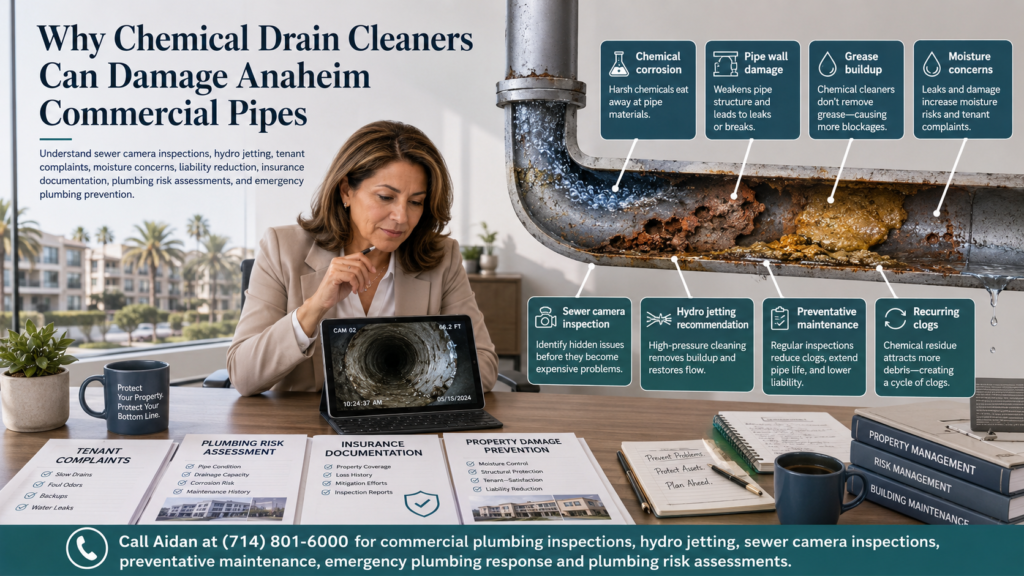
Chemical drain cleaners can damage commercial plumbing by generating heat, corroding pipe walls, weakening older drain lines, masking deeper blockages, and increasing the risk of leaks, tenant complaints, backups, moisture concerns, and emergency plumbing events. For Anaheim commercial properties, prevention starts with inspection, documentation, and proper drain maintenance.
Commercial property managers, facility managers, HOA managers, restaurant operators, retail center managers, and multifamily owners are often under pressure to solve plumbing complaints quickly. A slow drain sounds simple. A tenant is frustrated. A restroom is backing up. A kitchen sink is draining slowly during peak use. Someone reaches for a chemical drain cleaner because it seems cheap, fast, and convenient.
But in commercial properties, chemical drain cleaners can quietly turn a small plumbing issue into a larger operational risk.
For properties in Anaheim, Orange County, and nearby Southern California communities, the concern is not just whether the drain clears today. The real question is whether the pipe system is being weakened, whether the blockage is truly gone, whether documentation exists, and whether the property is protected from future damage.
Are Chemical Drain Cleaners Bad for Commercial Pipes?
Chemical drain cleaners can damage commercial pipes, especially in properties with aging plumbing infrastructure, repeated clog history, older cast iron lines, galvanized piping, PVC drain sections, grease buildup, root intrusion, or unknown pipe conditions.
They may temporarily open a drain, but they do not provide plumbing infrastructure intelligence. They do not show where the blockage is, what caused it, whether pipe walls are deteriorating, or whether hidden damage is developing behind walls, under slabs, or below landscaped areas.
For commercial properties, that lack of visibility creates risk.
Why Property Managers Should Be Careful With Chemical Drain Cleaners
A single bottle of drain cleaner may seem like a small maintenance decision. In reality, it can create several property management problems:
- Pipe corrosion
- Softened or weakened PVC
- Heat damage
- Worsening leaks
- Unresolved grease buildup
- Tenant safety concerns
- Incomplete documentation
- Delayed emergency plumbing prevention
- Increased liability exposure
- Insurance documentation gaps
In a commercial setting, plumbing decisions are rarely isolated. One slow drain can affect residents, tenants, employees, customers, vendors, maintenance teams, and ownership. That is why drain maintenance should be handled as a risk-management issue, not just a clog-removal task.
How Chemical Drain Cleaners Work
Most chemical drain cleaners are designed to dissolve organic material using strong reactive ingredients. Some create heat. Others use caustic or acidic chemistry to break down hair, soap residue, food matter, grease, or soft debris.
The problem is that commercial drain systems are rarely dealing with one simple clog.
In multifamily properties, retail centers, restaurants, medical offices, schools, and office buildings, slow drains may be caused by:
- Grease accumulation
- Scale buildup
- Pipe corrosion
- Bellied sewer lines
- Root intrusion
- Foreign objects
- Offset pipe joints
- Cracked drain lines
- Heavy use
- Improper slope
- Aging plumbing infrastructure
- Water pressure issues affecting the broader plumbing system
- Repeated tenant misuse
Chemical drain cleaners do not diagnose these conditions. They attack whatever is in the line and may also attack the pipe material itself.
The Hidden Problem: Chemical Drain Cleaners Can Mask the Real Cause
One of the biggest risks for Anaheim commercial properties is false confidence.
A drain may appear to improve after chemical treatment. Water may move a little faster. The tenant may stop complaining for a few days. The maintenance ticket may appear closed.
But if the real issue is grease buildup, root intrusion, pipe scale, an offset joint, or a sagging sewer line, the problem is still there.
That means the property manager may lose valuable time before:
- A backup reaches finished flooring
- Wastewater affects tenant spaces
- Moisture concerns appear behind walls
- Odor complaints increase
- A commercial kitchen experiences downtime
- A restroom becomes unusable
- A resident files repeated complaints
- An insurance-related incident becomes harder to document
This is why sewer camera inspections and plumbing risk assessments matter. They turn guesswork into documentation.
Pipe Damage Risk in Aging Anaheim and Orange County Properties
Many commercial properties in Anaheim, Orange County, and Southern California have plumbing systems that were installed decades ago. Even when buildings are well maintained, underground and behind-wall plumbing can age quietly.
Older drain systems may include:
- Cast iron pipe
- Galvanized pipe
- Clay sewer pipe
- ABS or PVC sections from past repairs
- Mixed-material drain systems
- Older joints and fittings
- Pipes affected by soil movement
- Pipes affected by long-term corrosion
Chemical drain cleaners can be especially risky when the condition of the pipe is unknown. If the pipe is already thin, corroded, cracked, or partially blocked, harsh chemicals may accelerate failure.
For a property manager, that means a maintenance shortcut can become a property damage prevention problem.
Why Chemical Drain Cleaners Are Risky in Commercial Kitchens
Commercial kitchens are high-risk plumbing environments. Restaurants, cafeterias, food-service tenants, hospitality properties, and shared-use kitchens often deal with grease, food particles, starches, fats, oils, and soap residue.
Chemical cleaners may create the impression that grease has been removed. But grease buildup often coats pipe walls over time. It does not always dissolve evenly. It may soften, move downstream, and harden again in another section of the line.
This can create a bigger problem later.
For commercial kitchen drains, hydro jetting is often a more appropriate preventative maintenance method because it uses high-pressure water to scour the inside of the pipe when the line condition supports it. When paired with sewer camera inspections, hydro jetting can help confirm whether the line is open, whether buildup remains, and whether additional repair planning is needed.
Why Chemical Drain Cleaners Are Risky in Multifamily Properties
In multifamily properties, tenant complaints are often the first warning sign of a plumbing issue. A slow tub drain, recurring toilet backup, or kitchen sink odor may seem like a unit-level problem. But repeated complaints can point to a shared branch line or main sewer issue.
Chemical drain cleaners in multifamily properties can create problems because:
- Tenants may use multiple products before reporting the issue
- Maintenance staff may not know chemicals are already in the line
- Chemicals can remain trapped behind a blockage
- Pipe damage may worsen without visible warning
- Repeated use may hide a larger shared-line problem
- Documentation may be incomplete if the issue later becomes a claim
For apartment managers and HOA managers, the risk is not only plumbing damage. It is resident satisfaction, liability reduction, and operational continuity.
A recurring drain complaint should not be treated as a one-time nuisance. It should be documented, investigated, and reviewed for patterns.
Commercial Liability Concerns
Chemical drain cleaners can also create safety and liability concerns for maintenance teams, tenants, vendors, and plumbers.
If chemicals are sitting in a blocked drain, anyone working on that line may face exposure risk. A plumber opening a cleanout, removing a trap, or using mechanical equipment can encounter chemical residue unexpectedly.
From a property management standpoint, this creates several concerns:
- Was chemical use documented?
- Who applied the product?
- Was the tenant informed?
- Was the maintenance team protected?
- Was the plumber notified before work began?
- Was there any chemical exposure risk?
- Were photos or notes added to the work order?
Good documentation helps protect the property, the vendor, and the management team.
Why Chemical Drain Cleaners Do Not Replace Sewer Camera Inspections
A sewer camera inspection provides visual intelligence. Chemical drain cleaners do not.
A sewer camera inspection can help identify:
- Grease buildup
- Root intrusion
- Cracked pipe
- Bellied sewer line
- Offset joints
- Standing water
- Scale buildup
- Foreign objects
- Pipe material
- Repeated blockage locations
- Maintenance priority levels
This matters for plumbing asset management.
When property managers can see what is happening inside the pipe, they can make better decisions about cleaning, repair, replacement, budgeting, insurance documentation, and emergency plumbing prevention.
Without inspection, decisions are based mostly on symptoms.
Chemical Drain Cleaners and Insurance Documentation
Insurance-related concerns often become important after a backup, leak, or water damage event. The problem is that by the time a claim is involved, documentation becomes critical.
Property owners and managers may need to answer questions such as:
- When was the issue first reported?
- Was this a recurring complaint?
- What action was taken?
- Was the line inspected?
- Was there evidence of maintenance?
- Were photos, videos, or service notes collected?
- Was the problem sudden, accidental, repeated, or preventable?
- Were chemicals used before professional service?
- Was there prior knowledge of deterioration?
Chemical drain cleaners usually do not create useful documentation. A professional plumbing inspection can.
For property damage prevention and insurance documentation, service records, camera footage, hydro jetting notes, moisture concerns, and repair recommendations can become important risk-management assets.
Plumbing Asset Management: Treat Drains Like Infrastructure, Not Annoyances
Commercial plumbing systems are assets. They support occupancy, customer experience, health and safety, tenant retention, and operational continuity.
A good plumbing asset management approach tracks:
- Drain complaint history
- Emergency plumbing calls
- Sewer camera inspection findings
- Hydro jetting dates
- Pipe material and condition
- Repeated blockage locations
- Moisture concerns
- Tenant complaints
- Maintenance actions
- Repair recommendations
- Budget planning needs
This kind of tracking helps property managers move from reactive repairs to preventative maintenance.
Chemical drain cleaners do the opposite. They encourage symptom chasing.
When a Slow Drain May Signal a Bigger Problem
A slow drain should be taken more seriously when it is recurring, shared, or connected to other symptoms.
Warning signs include:
- Multiple drains backing up at once
- Sewer odors
- Gurgling sounds
- Slow drainage after heavy use
- Recurring tenant complaints
- Wet flooring near restrooms or kitchens
- Moisture concerns near walls or cabinets
- Water backing up in lower-level units
- Drain flies or unpleasant odors
- Backups after rain or high-use periods
- Prior root intrusion or sewer line repairs
These signs may indicate a problem beyond the fixture itself. A chemical cleaner may temporarily change the symptom without solving the system failure.
Safer Alternatives to Chemical Drain Cleaners
For commercial properties, the safer path is to use a structured plumbing response process.
1. Document the Complaint
Record:
- Date and time
- Unit, suite, floor, or building area
- Fixture affected
- Tenant complaint details
- Photos or videos when available
- Prior related complaints
- Any chemical products already used
This helps with liability reduction and future insurance documentation.
2. Identify Whether the Issue Is Isolated or Shared
Ask whether nearby fixtures are affected. If more than one drain is slow, the issue may involve a branch line or main line.
3. Avoid Adding Chemicals Before Professional Service
If the blockage is severe, chemical products can sit in the pipe and create safety risks for anyone working on the line.
4. Use Mechanical Drain Cleaning When Appropriate
Professional drain cleaning equipment can remove blockages more directly than chemical products. The correct method depends on the pipe material, location, condition, and type of blockage.
5. Use Sewer Camera Inspections for Recurring Problems
If the same drain keeps backing up, inspect it. Recurring problems deserve visibility.
6. Use Hydro Jetting When Conditions Support It
Hydro jetting can be effective for grease, sludge, and buildup, especially in commercial kitchens and high-use lines. However, the pipe condition should be considered first.
7. Build a Preventative Maintenance Schedule
High-use commercial drains should be placed on a preventative maintenance plan based on use, history, and risk level.
Commercial Examples in Anaheim and Orange County
Multifamily Property
A lower-level apartment reports repeated tub and toilet backups. Chemical drain cleaner temporarily improves one fixture, but the problem returns. A sewer camera inspection reveals root intrusion in the shared line. Early inspection helps prevent larger tenant complaints, moisture damage, and emergency displacement risk.
Restaurant Tenant
A restaurant kitchen line slows during dinner service. Staff use chemical cleaner repeatedly. The issue continues. Hydro jetting and camera inspection reveal heavy grease buildup downstream. A planned maintenance schedule reduces emergency plumbing calls and protects operational continuity.
Retail Center
A public restroom drain backs up twice in one month. Chemical use clears the fixture briefly. Inspection reveals an offset joint and standing water. Documentation helps ownership plan repairs before a larger customer-facing incident occurs.
HOA or Condo Community
Several residents report sewer odors and slow drains. The issue is initially treated as isolated. Camera inspection shows aging plumbing infrastructure and buildup in shared lines. The HOA uses the findings for budgeting, communication, and liability reduction.
Why This Matters for Resident and Tenant Satisfaction
Plumbing problems are emotional. Tenants and residents rarely see the pipe. They experience the disruption.
They notice:
- Odor
- Slow drains
- Water on floors
- Repeated inconvenience
- Closed restrooms
- Delayed response
- Lack of communication
- Fear of hidden damage
For property managers, this becomes a trust issue. When plumbing complaints are handled with documentation, inspection, and prevention, residents feel the property is being managed responsibly.
When issues are repeatedly treated with temporary fixes, frustration grows.
The Better Property Management Question
Instead of asking, “What can we pour down the drain?” a stronger question is:
“What does this drain problem tell us about the condition of the plumbing system?”
That shift changes everything.
It moves the conversation from quick reaction to risk reduction, from tenant appeasement to infrastructure intelligence, and from emergency response to preventative maintenance.
Recommended Commercial Drain Policy
Commercial properties should consider a simple internal policy:
- Do not use chemical drain cleaners as the first response for recurring or unknown drain problems.
- Document all tenant complaints related to slow drains, odors, backups, and moisture concerns.
- Escalate repeat drain issues for sewer camera inspections.
- Use hydro jetting strategically for grease and buildup when pipe condition supports it.
- Track drain issues by building, unit, suite, and line location.
- Maintain service records for insurance documentation and liability reduction.
- Build preventative maintenance schedules for high-use plumbing areas.
This type of policy protects the property and helps managers make decisions based on evidence.
FAQ: Chemical Drain Cleaners and Commercial Plumbing
Are chemical drain cleaners safe for commercial buildings?
They may be risky, especially in buildings with aging plumbing infrastructure, unknown pipe conditions, recurring clogs, grease buildup, or older pipe materials. Commercial properties should avoid relying on chemical cleaners for repeated or unexplained drain issues.
Can chemical drain cleaners damage PVC pipes?
Yes, some chemical cleaners can create heat or reactions that may weaken plastic pipe, fittings, seals, or older repaired sections, especially with repeated use or when chemicals sit behind a blockage.
Can chemical drain cleaners damage cast iron pipes?
They can contribute to corrosion risk, particularly when pipes are already aging, scaled, cracked, or deteriorated. Cast iron lines in older Southern California buildings should be evaluated carefully before repeated drain treatment.
Why do drains keep clogging after chemical cleaner is used?
The cleaner may only create a small temporary opening. The real problem may be grease buildup, roots, pipe scale, a bellied sewer line, an offset joint, or a deeper blockage that requires professional cleaning and inspection.
Is hydro jetting better than chemical drain cleaner?
For many commercial drain systems, hydro jetting is more effective for removing grease, sludge, and buildup. However, the pipe condition should be evaluated first, often with a sewer camera inspection.
When should a property manager request a sewer camera inspection?
Request a sewer camera inspection when drain problems are recurring, affect multiple fixtures, involve sewer odors, create tenant complaints, or occur in high-risk areas such as commercial kitchens, restrooms, lower-level units, and older buildings.
How does documentation help with plumbing risk?
Documentation helps show what was reported, when action was taken, what was found, and what recommendations were made. This supports liability reduction, insurance documentation, budgeting, and property damage prevention.
Should tenants be allowed to use chemical drain cleaners?
Commercial property managers may want to discourage tenant use of chemical drain cleaners because it can create pipe damage, safety risks, incomplete maintenance records, and unknown chemical exposure for plumbers or maintenance staff.
Summary: Chemical Drain Cleaners Are a Shortcut, Not a Strategy
Chemical drain cleaners may appear to solve a drain problem quickly, but they can damage pipes, hide larger plumbing issues, create safety concerns, and weaken documentation. For Anaheim, Orange County, and Southern California commercial properties, the better strategy is inspection-first plumbing management.
Sewer camera inspections, hydro jetting, preventative maintenance, plumbing risk assessments, and proper documentation help protect residents, tenants, buildings, budgets, and ownership from avoidable plumbing emergencies.